

The era of A9 keyword density is ending. Amazon’s COSMO algorithm now prioritizes "Commonsense Knowledge" over lexical matching. Learn why your "Exact Match" strategy is leaving you invisible to high-intent traffic.
January 5, 2026
For the last ten years, the logic of Amazon’s A9 algorithm was binary: strict keyword matching. If a user searched for "10-inch skillet," and your backend search terms contained "10-inch skillet," you were indexed.
This created an ecosystem of "Keyword Stuffing," where titles were written for robots, not humans.
That era is closing. Amazon has deployed COSMO, a large-scale system that utilizes Large Language Models (LLMs) to mine "commonsense knowledge" from user behavior. Unlike A9, COSMO does not just analyze what a user types; it deduces why they are typing it.
Traditional e-commerce knowledge graphs suffer from a structural flaw we call the Semantic Gap.
A standard database tags a product as a "10-inch cast iron skillet." However, a high-intent customer often searches for "searing steak" or "camping cookware."
Under the old A9 logic, unless you explicitly stuffed "searing steak" into your backend keywords, you remained invisible. COSMO bridges this gap by generating "Knowledge Triples"—structured logic statements that link products to intents without requiring exact keyword matches (e.g., Camera Case > Capable Of > Protecting Camera).
The implication for the Scaling Operator is critical: Contextual Relevance now outweighs Keyword Density.
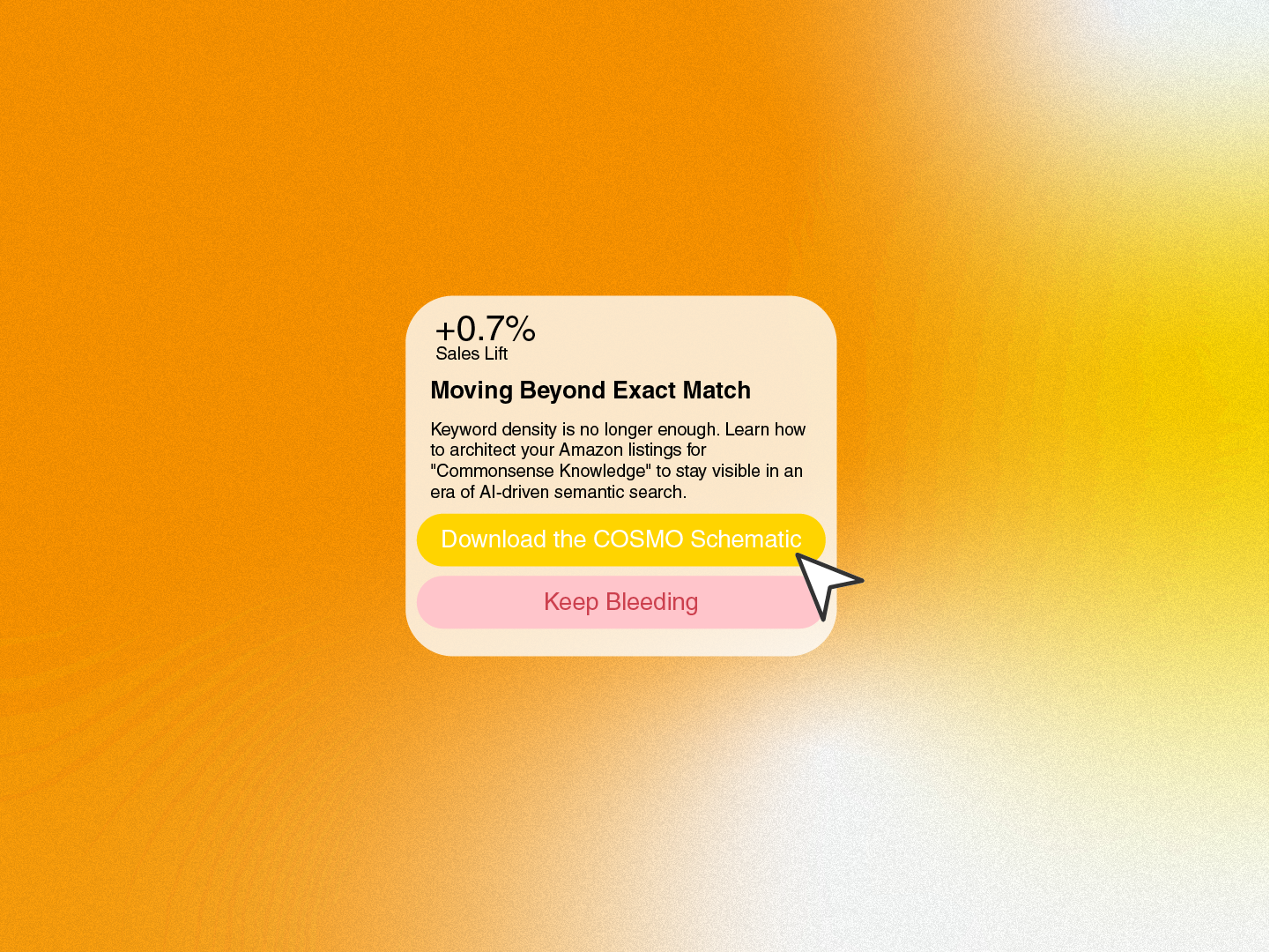
In online A/B testing covering roughly 10% of U.S. traffic, COSMO drove a 0.7% increase in sales by prioritizing listings that solved for intent rather than just matching strings.
If your listing is optimized solely for "Exact Match" keywords but lacks the semantic context of function (what the product does) and occasion (where it is used), you are structurally invisible to the new "Reasoning Factor Graph."
You cannot hack this algorithm. You must architect for it. This requires a fundamental shift in how you write titles, bullets, and A+ content—moving from "String Matching" to "Natural Language Understanding" (NLU).
This was the theory. Now get the schematic.
We have published a technical standard detailing exactly how COSMO mines "Co-Buy" and "Search-Buy" behaviors to build its knowledge graph.